
Multiple Sale Scam in Bangladesh Land & Apartment
It sounds like something from a crime film, but it actually happens in Bangladesh property transactions more often than you’d think. This is the result of a back-dated and manual land management system. In a Multiple Sale Scam in Bangladesh, a seller accepts your payment for a plot of land, hands over documents, disappears, and then you discover the property has already been sold via registered deed to someone else.
By law, only the first registered buyer has a legitimate claim. You are left with only few forged documents and long harrasment.
This is the Multiple Sale Scam in Bangladesh that can destroy your investment overnight.
What Is the Multiple Sale Scam?
In its simplest form, the Multiple Sale Scam in Bangladesh for land or apartment refers to the sale of a single land, plot or apartment to multiple buyers in sequence, hiding the earlier sale from later buyers.
This happen like; The seller collects full or partial payment from each buyer, provides duplicate or forged documents to each, and make belive every buyer that they own the same property.
In Bangladeshi law, however, only the first registered buyer who registers the deed with the Sub-Registry office holds a legitimate legal claim. Any subsequent buyer has no legal rights, regardless of how many “original” documents they hold or how much they paid.
The scammer counts on two things:
- Buyers will be pushed to skip the legal vetting to save time and money
- Seller will delay registering the deed, excusing Power of Attorney, Succession Documents, or other process of land sale
By the time the truth reveals, the scammer is gone and the property is already registered in someone else’s name.
How Does a Multiple Sale Scam in Bangladesh Actually Work?
The multiple sale scam in Bangladesh has grown due to gaps in the legal framework, weak digitalization, and corrupt connections between scammers and land & registration office staff. It’s not just an individual offence. Many of the prominent real estate developers run these schemes systematically.
Let’s dive into two real scenarios
Scenario A: Individual Seller Fraud
Case 1: The Canadian Buyer in Demra
In 2022, one of our clients living in Canada purchased a plot of land in Demra Staff Quarter. The seller claimed ownership via Power of Attorney (POA). Our client, trusting because the seller was distantly related, skipped legal vetting.
When our client applied for mutation months later, the government rejected it. The land office had no record (jote) of allowable land in that sector. Further investigation revealed the truth: the POA-giver (the real owner) had secretly sold the entire property to someone else.
The legal question became impossible to answer: whose sale was valid—the POA holder’s or the original owner’s? Our client lost both time and money.
Case 2: The Heba Fraud in Dhanmondi
In another case, a seller registered a heba (gift deed) in favor of our client at the Sub-Registry office. However, just two days before the saf-kobla (final deed) registration, the same seller had secretly created a heba deed in favor of his two sons.
When our client tried to complete the registration, three competing claims surfaced. Years of litigation followed.
Scenario B: Developer Company Fraud
Real estate developers operate two models:
- Land Developers: Buy land, fill and demarcate it, then sell individual plots to buyers
- Real Estate Developers: Sign joint venture agreements with landowners, build apartments, and sell units
In both cases, buyers preliminarily sign unregistered agreements with an installment schedule. Once payments are complete and the property is ready, the deed is registered.
Here’s where the scam happens:
- The developer signs an unregistered agreement with you and collects regular installments
- Before completion, as the market expands and prices rise, the developer resells the same property to a second buyer at a higher price
- The deed is registered in the second buyer’s name
- When you complain, the developer offers you these “options”:
- Cancel your allotment and forfeit 6-10% as cancellation and service fees
- Accept a shift to a different, lower-value property
- Accept delayed possession indefinitely
Some unscrupulous companies register the same property multiple times. When the last buyer objects or files a case, the company relies on policies to refuse refunds or shift the liability.
How a Multiple Sale Scam in Bangladesh Works
Step 1: Identify a Desirable Property
The scammer targets a valuable, easy-to-sell property, usually:
- Undivided (ejmaly) or joint family property
- Inherited land with multiple hidden heirs
- Property in a growing area of Dhaka or suburbs
For example, suppose a land has 7 owners (2 brothers and 5 sisters), but you only get registered through 1-2 of them. After your registration, the other 5 co-owners can legally claim and sell their portion to others, creating competing claims and endless disputes.
Step 2: Forge or Misuse Power of Attorney
The scammer poses as the real owner using:
- A forged deed or power of attorney
- A stolen or forged national ID card
- A legitimate POA obtained from the real owner, but secretly cancelled
- Unregistered claims on jointly-owned property
Step 3: Sell to the First Buyer
The scammer signs a bayna (sale agreement) and collects full or partial payment. They hand over copies of documents and promise to register the Saf-kobla deed later.
Step 4: Sell to the Second Buyer
While the first buyer is still arranging funds or waiting to register, the scammer contacts a second buyer. Same documents. Same story. Another full payment collected.
Step 5: Register in a Preferred Name
The deed gets registered in the name of:
- A trusted accomplice
- A fake buyer created on paper
- One of the actual buyers (usually the last one with the most cash or influence)
By the time other buyers discover the fraud, the registration is complete and the scammer has vanished.
How to Detect the Multiple Sale Scam in Bangladesh
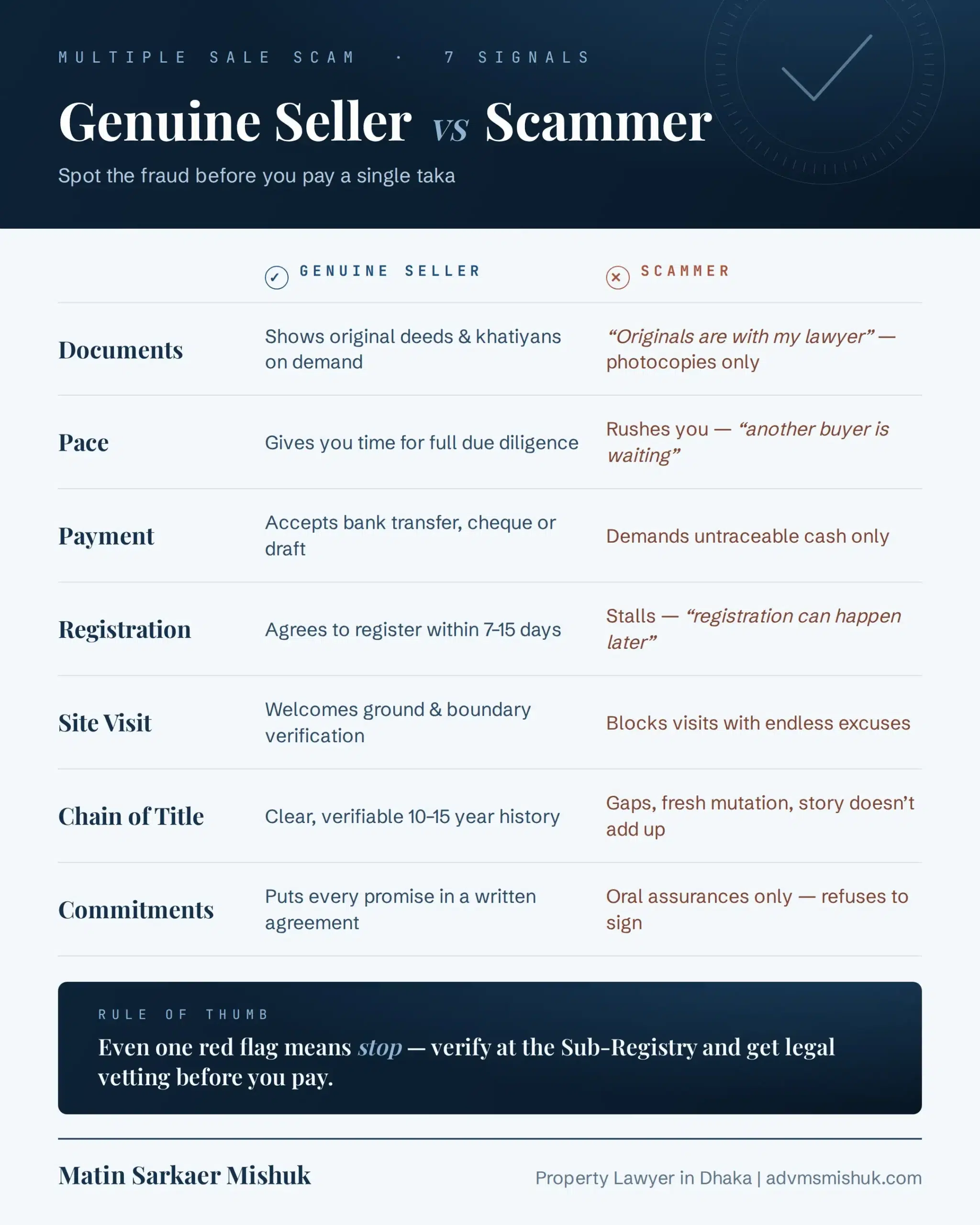
A multiple sale scam in Bangladesh land and apartment sales is detectable if you notice these warning signs in time. Never ignore them. The following red flags are based on real cases we’ve handled, and each one is a critical signal to stop, investigate, and seek professional help before you pay a single taka.
(A) The Seller Rushes You
One of the most common tactics scammers use is creating artificial urgency. You’ll hear something like: “We need the money by tomorrow. Another interested buyer is waiting.” Or: “The seller is seriously ill and needs money for treatment.” Or: “We’re leaving for Hajj or abroad and need immediate funds.”
The scammer understands that a property transaction is the biggest financial decision of your life and that you need time to do proper due diligence. A genuine seller will be patient and transparent. Scammers, on the other hand, know that once you start asking questions and doing your homework, the fraud will be exposed.
What should you do? Take your time. A real deal will still exist after a proper check. Walk away from rushed deals. If someone is pressuring you to move fast, it’s because they don’t want you to discover the truth.
Read our guide on Legal due diligence before buying land to understand how much time you actually need for a safe transaction.
(B) The Seller Won’t Show Original Documents
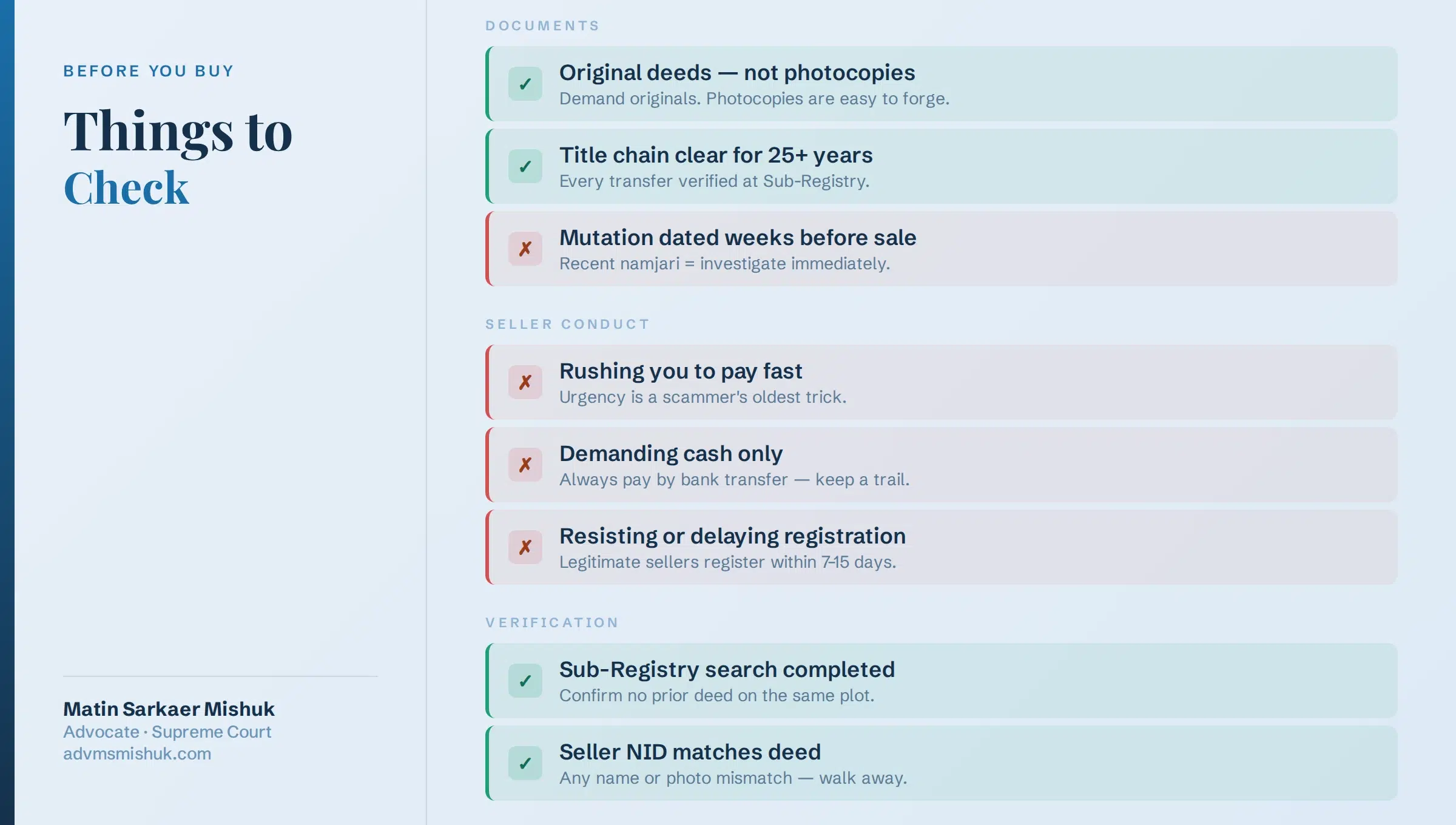
You hear this often: “The originals are with my lawyer. You can have photocopies for now.” Original deeds (saf-kobla), khatiyans, certificates, and other ownership documents should always be in the seller’s possession. Yes, a lawyer might hold them briefly for safekeeping, but the seller must be able to produce the originals on demand without excuses.
Why is this important? Photocopies are easy to forge. The original documents have specific security features, watermarks, and the official stamp of the Sub-Registry that are nearly impossible to duplicate. When a seller avoids showing originals, they’re usually hiding the fact that the documents are fake or that they don’t actually own the property.
(C) Multiple Copies of the Same Deed Circulating
This is perhaps the most direct evidence of a multiple-sale scam. Your lawyer discovers that the same deed has been shown to other buyers. This is not coincidence. This is the scam in action. It means the seller has been collecting payment from multiple buyers for the same property, handing each one a photocopy of the same deed, and disappearing before anyone can register.
(D) The Seller’s Name Doesn’t Match Documents
Pay close attention to names and signatures. The deed says “A. Hasan” but the person in front of you claims his name is “Abdur Hasan.” Or the national ID photo clearly doesn’t match the person trying to sell you the property. Or the signature on the deed looks completely different from the signature on the bayna (sale agreement).
Small inconsistencies hide big frauds. Scammers often steal or forge identity documents. They might be using a name slightly different from the deed to avoid detection. They might have used someone else’s national ID when registering the property years ago.
(E) The Mutation (Namjari) Is Recent or Suspiciously Timed
Look at the dates carefully. The latest khatiyan shows the property in the seller’s name, but the mutation is dated just weeks or months before the sale. This is suspicious. It suggests the seller recently acquired the property, possibly fraudulently.
Modern scammers have made this easier. Mutations are now digitized in many districts of Bangladesh. A skilled scammer can print high-quality color copies of official mutations that look completely authentic. Some corrupt land office staff can even create fake mutations. Always verify directly with the land office before you register to confirm the continuity of ownership.
Check the land office records personally or through your lawyer. Visit the Sub-Registry and confirm that the mutation is genuine and that the seller’s name has been in the land office records for a reasonable time. Recent mutations warrant deep investigation.
(F) No Clear Chain of Transfer
Every property has a history. If the seller acquired the property through someone else, there should be a clear, documented chain showing how the property changed hands:
Original Deed → Mutation → Transfer Deed → Current Owner’s Name
Each step should be documented, registered, and verifiable at the Sub-Registry. But scammers often break this chain. They might have acquired the property illegally, forged the transfer, or skipped registration steps. When you ask them to explain how they got the property, their story doesn’t add up or they get defensive.
Request a complete chain of ownership going back at least 10-15 years. Each step must be documented and verified at the Sub-Registry. If there are gaps in the chain, if documents are missing, or if the seller can’t explain how they acquired the property, you’re in danger. Don’t buy. A lawyer can trace the full chain and spot any breaks or irregularities.
(G) The Seller Resists Immediate Registration
Listen carefully to what the seller says about registration. If you hear: “Let’s complete the sale first. Registration can happen later we’re too busy right now” or “Don’t worry about registration. You’ll get it done eventually”—these are major red flags.
Legitimate sellers understand that immediate registration protects both parties. It makes the sale final and official. A seller who resists or delays registration is often hiding something.
The seller might be planning to sell the property to someone else before you can register.
Or might know that the property has a problem that will show up during the registration process.
Or might be stalling to buy time to disappear.
Always insist on registration within 7-15 days of payment. This is non-negotiable. Make it a condition in your sale agreement that registration must happen within this timeframe. If the seller refuses or delays, don’t pay. A legitimate sale deed can be registered quickly once all documents are in order and the seller agrees. If they won’t agree to fast registration, walk away.
(H) The Seller Demands Cash Only
This is a major red flag that most buyers ignore until it’s too late. Scammers avoid bank transfers and cheques because they create a paper trail. A bank transfer leaves a record. A cheque is traceable. Cash, on the other hand, is hard to trace and nearly impossible to recover once it’s gone.
When a seller insists on cash payment especially for a large amount, they’re often planning to disappear. They want no record of receiving the money. They want to be able to deny the transaction if you come looking for them later.
(I) The Seller Won’t Let You Visit the Property
The seller gives you excuses: “It’s under renovation right now.” Or: “The tenant is living there, we can’t disturb.” Or: “It’s too far to visit, just trust me on the documents.”
If the seller blocks your access to the physical property or won’t allow ground verification, they’re hiding something. Maybe the property doesn’t exist. It’s may be much smaller or in worse condition than described. There’s someone else may living there who has a claim on it. Maybe it’s government land or under acquisition. Whatever the reason, a seller with nothing to hide will always let you visit.
What you must do: Always visit the property yourself. Check the boundaries against the mouza map. Speak to the neighbors and ask about the property’s history and ownership. Ask the people living nearby if they know of any disputes or if anyone else claims ownership. Ground verification is one of the most important checks you can do. If the seller won’t let you visit, don’t buy.
(J) Developers Make Only Oral Commitments
This is especially common when buying apartments or plots from real estate developers. A developer will sit with you, smile, and make grand verbal commitments: “Don’t worry, we’ll give you a parking space.
But when you ask to put it in writing, they refuse. They say, “Don’t worry, we’ll handle everything. Our policy is to keep things flexible.”
Oral promises have zero legal value. If the developer fails to deliver on a verbal commitment, you have no proof, no contract, and no way to force them to honor it. This is how developers systematically defraud buyers.
Keep everything in writing. Before you pay a single taka, get a written agreement that specifies:
- Exact specifications of your unit (size, facing, floor, parking)
- Exact date of possession
- What happens if possession is delayed (refund clause, penalty for developer)
- What happens if specifications change (compensation/adjustment)
- Conditions for cancellation and refund
- Set a clause for dispute resolution
Make all clauses hard and clear. No vague language. No “subject to availability.” Never trust a developer’s word alone. Oral commitments are worthless.
What Comes Next: Professional Verification
If you’ve noticed any of these red flags, stop the transaction immediately. Don’t think “Maybe it’s fine.” “I’ll handle it after I pay.” Don’t hope for the best.
The moment you see one of these warning signs, contact a qualified property lawyer who specializes in real estate and fraud detection. The cost of legal vetting (15,000-60,000 taka) is infinitesimal compared to losing your entire investment.
A lawyer will:
- Conduct a comprehensive title search going back 25+ years
- Verify every mutation and transfer document
- Search for prior sales, competing claims, and court cases
- Confirm the seller’s actual legal ownership
- Check for hidden mortgages or charges
- Verify developer authority and building approvals (for apartments)
Legal Remedies of Multiple Sale Scam in Bangladesh
Discovery of a multiple-sale fraud is devastating. You have paid good money, trusted official-looking documents, and perhaps even taken possession of a property that legally belongs to someone else. At this point, one instinct drives many victims: to wait and hope the seller reappears with an explanation. That instinct will cost you everything. The law can only protect those who act quickly and correctly.
If you suspect that you have been a victim of a multiple-sale scam, take immediate legal action. Here is what you must do, step by step.
Step 1 — File a General Diary (GD) Without Delay
Your very first move is to walk into your local police station and file a General Diary (GD). Do not wait for certainty. Do not wait for a lawyer’s opinion. File the GD the moment you have reasonable grounds for suspicion.
- Bring your payment receipts, booking agreement, and any documents handed over by the seller.
- State clearly in the GD that you suspect fraud that the property may have been sold to more than one buyer simultaneously.
- Simultaneously, send a formal legal notice to the seller/developer by registered post, putting them on official notice of the fraud.
- If there is any arbitration clause agreed in the agreement. Call for arbitration at once.
A GD is not just a complaint it creates a time-stamped legal record of your knowledge of the fraud. This record becomes critical evidence in both civil and criminal proceedings.
Step 2 — Initiate Criminal and Civil Legal Action
Filing a GD alone is not sufficient. You must follow it with formal legal proceedings. Depending on the nature of the fraud, two primary legal routes are available to you:
A. Criminal Case for Fraud and Cheating
File a criminal case under the Penal Code, 1860. Relevant offences include cheating (Section 420), forgery (Sections 463–471), and criminal breach of trust (Section 406). A conviction carries imprisonment and can compel the fraudulent seller to make restitution.
B. Case under the Negotiable Instruments Act, 1881
If the seller or developer issued a post-dated cheque whether as a booking confirmation, a payment receipt, or a refund commitment and that cheque has bounced or been dishonoured, you have a separate and powerful legal remedy. File a case under the Negotiable Instruments Act, 1881. Dishonour of a cheque is a criminal offence carrying up to one year’s imprisonment and a fine equivalent to twice the cheque amount.
A bounced cheque case must be filed within 30 days of receiving the dishonour notice from your bank. Missing this window bars you from using this remedy entirely. Act immediately.
Step 3 — File a Complaint with the Consumer Rights Authority
Where there is documented evidence of Multiple Sale Scam in Bangladesh false brochures, misleading price lists, phantom apartment bookings, or misrepresentations of ownership you may also file a formal complaint with the Directorate of National Consumer Rights Protection (DNCRP).
- DNCRP has the authority to investigate, impose penalties, and direct refunds in cases of consumer deception.
- This route is particularly effective against real estate developers who have misrepresented projects to multiple buyers.
- It operates in parallel to not instead of, your criminal and civil proceedings.
Consumer rights protection is not a weak remedy. In recent years, the DNCRP has imposed significant penalties on developers caught in multiple-sale and false-representation schemes. Use it.
A property fraud case weakens with every passing week. The fraudster may flee, destroy records, or register the property to a third party in the interim. Time is not on your side, consult a property lawyer immediately.
Consult a Property Lawyer in Dhaka
Matin Sarkaer Mishuk
Advocate, Supreme Court of Bangladesh

Frequently Asked Questions
Q1. Can I recover my money if I am a victim of a multiple-sale scam?
Recovery is possible but not guaranteed. If the deed was registered to someone else before you, you have no property right but you can file a criminal fraud case under the Penal Code, 1860 and a civil suit for damages.
If the seller’s cheque bounced, file under the Negotiable Instruments Act, 1881 within 30 days of dishonour.
Q2. What happens if two buyers both have registered deeds for the same property?
The first registered buyer holds the legitimate title under the Transfer of Property Act, 1882. Any later registration is void in law.
Q3. Is a Power of Attorney safe for property transactions in Bangladesh?
A registered POA is legal but it is one of the most abused instruments in property fraud. A genuine POA may have been secretly cancelled by the real owner. It may be forged entirely. Always verify the POA’s validity directly at the Sub-Registry before any transaction.
Q4. How do I check if a property has already been sold?
A title search at the Sub-Registrar’s Office covering 25 years is the only reliable method. It reveals all prior deeds, transfers, and mortgages. Have a property lawyer in Dhaka conduct this they can spot forged or out-of-sequence entries that an untrained buyer would miss. Online mutation records are supplementary, not a substitute.
Q5. What is the cheapest way to protect myself from property fraud?
Legal vetting before you pay. A full title search costs BDT 15,000 to 60,000. Against a property worth crores of taka, that is not a cost it is the cheapest protection you can buy. In every fraud case we have handled, the victim skipped this step.
Q6. Can ejmaly (jointly-owned) property be sold without all co-owners’ consent?
No. Each co-owner can only sell their specific share. But a scammer may register through one or two co-owners and hand you documents suggesting full title. The remaining co-owners keep their legal rights and can sell or litigate against you.
Q7. How long does a property fraud case take in Bangladesh?
Civil title disputes typically run three to eight years. Complex fraud cases can go longer. Once you are in litigation, time, money, and certainty are gone. The only effective strategy is prevention. One legal check before payment eliminates years of court proceedings.